We call you
Programme in Clinical Optometry and imaging techniques in ophthalmology
Start
10 January 2027
Duration
12 months
ECTS
60
Registration
6.000€
Objective
This course is aimed at Diploma Graduates / Graduates in Optics and Optometry, Diploma Graduates/Graduates in Nursing and Graduates in Medicine, with some previous experience and an interest in updating their knowledge of new technology and its application in ophthalmology.
Teachers
- Coordinador: Sr. Silvia Funes Ávila
- Sra. Paulina Hernández
- Sr. Alfons T. Margalef
- Sra. Anna Vaquero
Evaluation
The evaluation of the student will be done on a continuous basis and with the presentation of a final postgraduate work. Attendance and the final project are compulsory.
Registration
- The registration fee is € 6.000. It must be paid by bank transfer.
Program
General principles:
- Ocular anatomy and physiology: anterior pole, ocular appendages, posterior pole and optic pathways.
- Ocular pathology: most prevalent pathologies of the anterior pole, ocular appendages, posterior pole.
- Surgery in Ophthalmology:
- Indications.
- Previous tests.
- Surgery on eyelids, lacrimal apparatus, orbit, cornea, crystalline lens and retina.
- Types of lasers in ophthalmology.
- Safety measures.
- Most commonly used drugs in ophthalmology:
- Indications.
- Routes of administration.
Medical history and basic examinations:
- Anamnesis.
- Visual acuity.
- Tonometry.
- Refraction.
- Corneal biomicroscopy
- Evaluation of the anterior camera
- Pupillary reflexes
- Binocular vision assessment:
- Cover-Test, Ocular Motility, Fusion, Stereopsis
Contactology
- Adaptation of contact lenses in irregular corneas (keratoconus, ectasia,keratoplasties, etc).
- Special adaptations (Contact lenses)
Low vision:
- Low vision: features and classification. Different therapies in patients: Indications and tests by Visual rehabilitation, aids visual (magnifying glasses, filters), acuity visual.
- Evaluation of specific visual acuity due to low vision (different types of tests).
Practical optometry and vision therapy.External eye photography:
- Pediatric optometry. Differences of the pediatric patient. Protocols and treatments.
- Vision therapy of different types of pediatric patient and visual training.
Anterior segment slit-lamp photography:
- Characteristics of the photographic slit lamp.
- Accessories, illumination techniques and indications, protocols according to pathology, angle photography.
- Evaluation of vision in the pediatric population with specific tests and tests. Introduction to vision therapy (visual training practices).
Surgery in ophthalmology:
- Indications and previous tests. Type of laser in ophthalmology. Type of surgery for each specialty.
- Type, indications and ways of administration.
Introduction to the methodology of Research
- Introduction to the methodology of research
- Drafting of research protocols
- Institutions and documentation for the Presentation of projects research to ethics committees and regulators
- Analysis of results and dissemination
Refractive Surgery: Complementary and preoperative Tests:
- LASIK technique, FEMTO and management of refractive surgery equipment, basic instruments.
- Biometrics, topography, endothelial count, tear tests, Lancaster test, Video oculograph
External photograph of the eye:
- Basic concepts in photography and protocols according to pathologies.
- Types of cameras
Photograph of the anterior segment with slit lamp:
- Features of photographic crack light
- Accessories, lighting techniques and indications, protocols according to pathologies, angle photography
Fundus photography and Optical coherence tomography:
- Fundus photography, characteristics, color fundus photography, fundus autofluorescence photography, fluorescein angiography and with indocyanine green, stereoscopic and panoramic fundus photography, adverse effects of contrast, indications and protocols according to disorder.
- Anterior segment OCT, high resolution posterior segment OCT.
- Ultrasound techniques:
- Ultrasonic Biomicroscope.
- Ultrasound B Posterior segment.
Send us a message if you have any doubts
You may be interested in


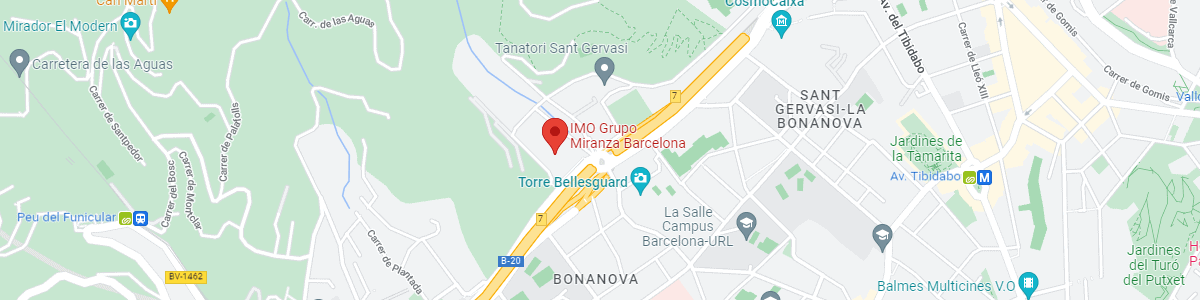
IMO Institute of Ocular Microsurgery
Josep María Lladó, 3
08035 Barcelona
Phone: (+34) 934 000 700
E-mail: international@imo.es
See map on Google Maps
By car
GPS navigator coordinates:
41º 24’ 38” N – 02º 07’ 29” E
Exit 7 of the Ronda de Dalt (mountain side). The clinic has a car park with more than 200 parking spaces.
By bus
Autobus H2: Rotonda de Bellesguard, parada 1540
Autobus 196: Josep Maria Lladó-Bellesguard, parada 3191
Autobuses H2, 123, 196: Ronda de Dalt – Bellesguard, parada 0071
How to arrive at IMO from:
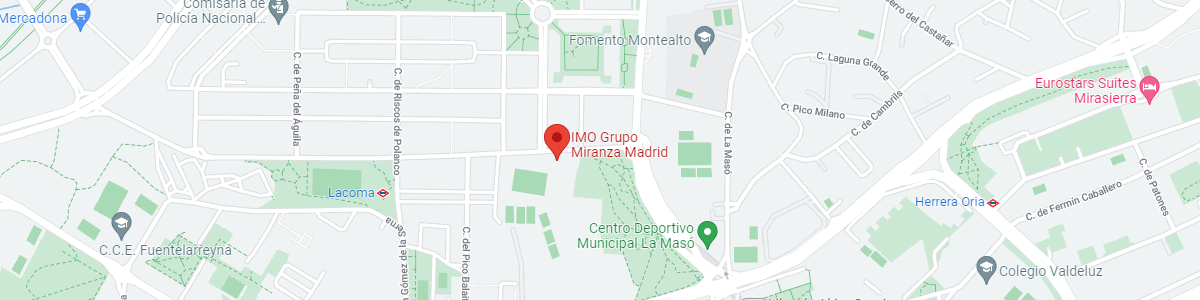
IMO Madrid
C/ Valle de Pinares Llanos, 3
28035 Madrid
Phone: (+34) 910 783 783
E-mail: administracion.madrid@imo.es
Public transport
Metro Lacoma (líne 7)
Autobuses:
- Lines 49 & 64, stop “Senda del Infante”
- Line N21, stop “Metro Lacoma”
Timetables
Patient care:
Monday to Friday, 8 a.m. to 9 p.m.
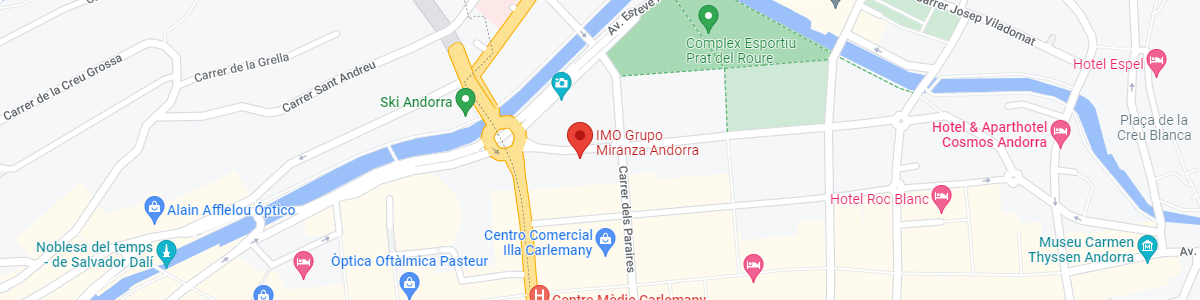
IMO Andorra
Av. de les Nacions Unides, 17
AD700 Escaldes-Engordany, Andorra
Phone:(+376) 88 55 44
See map in Google Maps