We call you
FAQs

Eyelid tumours can be confused with styes, small spots or red lumps that appear on the edge of the eyelid (on the inside and outside of the eyelid).
The main difference is that styes are more acute –they appear and disappear in a few days and are intensely bothersome and painful–, whereas eyelid tumours are more silent. In other words, they have a slower evolution and often grow gradually, in most cases causing no pain whatsoever.
Given current lifestyles, we spend most of our time using near vision to read, work on the computer, look at our mobile phones, etc. different situations in which we “forget” to blink (we do so around half the number of times as with distant vision). As a result of less blinking, the tears are not correctly spread over the whole surface of the eye and the eye becomes dry, activating the production of small quantities of tear secretion to make up for the problem. Given that the tear’s response does not remain for long enough on the eye to correct the problem of dryness, it continues to produce tears, which end up overflowing and causing watery eyes.
The location of a blocked tear duct will determine the importance of solving the subsequent water eye problem. If the patient has a high blockage, i.e. in the lacrimal canaliculi (small ducts located on the eyelids), this is often merely a bothersome problem because of permanent watery eyes. However, when the blockage is lower and is located after the lacrimal sac, this may become infected due to the accumulation of tears and lead to dacryocystitis (inflammation of the lacrimal sac). This could eventually generate more serious problems, such as orbital cellulitis (infection of the fat and muscles around the eye).
Watery eyes may be more or less bothersome depending on each patient, but it is important to consult a specialist especially when watery eyes are associated to red eyes, pain and/or secretion. It should also be checked when a problem is no longer occasional and becomes permanent.
No very complex or painful examinations are required to detect glaucoma and determine its type and stage. The most important tests when making the diagnosis include an examination of the optic nerve –either directly or using automated tests such as the OCT– and the measuring of intraocular pressure (tonometry). In addition to these, a visual field test is performed to determine the stage of the disease, visualisation of the angle formed by the cornea, iris and sclera to classify the type of glaucoma (gonioscope) and measurement of the corneal thickness, as this can have an impact on intraocular pressure (pachymetry).
Glaucoma causes a progressive decrease in the patient’s visual field, and his or her peripheral vision is gradually reduced. It is therefore difficult to notice this gradual loss until the disease is at an advanced stage and the visual field has been greatly and irreversibly reduced.
The myth of people with glaucoma seeing a black tunnel is not true, as the “appearance” of the disease varies depending on each person and the extent to which the visual field is affected. Some patients describe blurred vision, mistiness or blind spots, although they often find it difficult to explain what is wrong and may confuse glaucoma with other eye diseases such as cataracts.
It is an important factor in glaucoma, although the genetic bases of the disorder are heterogeneous: there are some cases of direct transmission from generation to generation (such as congenital glaucoma) and other cases of complex inheritance (e.g. pseudoexfoliation glaucoma) where a higher percentage of sufferers in the same family than the population average is observed. In both circumstances, genetic studies provide the opportunity to detect possible future cases of glaucoma.
While genetic research continues to progress to increase knowledge in this field, it is important for patients with a family history of glaucoma to be aware of the greater risk they are at to suffer the disease. It is therefore recommendable for people with sufferers of glaucoma in their family (parents, siblings and/or children) to take annual ophthalmological controls from the age of 40 at the very latest.
When the quality or the quantity of tears is not good –within a certain range– the body reacts and stimulates the secretion of tears as a protective measure. A circle is started: the eye perceives that it is dry and produces a little tear secretion, although because this is still not enough and does not solve the problem, it perceives it is dry again and produces a little more. This continues until the capacity of the tear drainage system is exceeded, leading to watery eyes.
Therefore, the use of artificial tears in patients with dry eye mostly solves the watery eye problem, as the eye is correctly lubricated and the balance is re-established.
Seasonal eye allergies most affect the eyes in spring and summer, as this is the period of pollination. Seasonal allergic conjunctivitis, which is primarily associated to pollen, is the most prevalent form of eye allergy and its main symptom is itching, as well as redness, water eyes, swollen eyelids and a feeling of burning or of a foreign body.
Another seasonal eye allergy that must be considered is vernal keratoconjunctivitis, which is typical in children and that also often appears in spring and summer. In this case, the symptoms are more serious because, apart from itching, vision can be threatened by the injuries caused to the cornea.
To a greater or lesser extent, conjunctivitis is often associated with watery eyes, as the production of tears – responsible for “cleaning” the eye’s surface – increases like a defence mechanism for the body against any of the factors causing the disorder (virus, bacteria, mites, pollen, chlorine from swimming pools, etc.).
There are different causes for and types of dark circles. Hereditary dark circles present in some families are genetic and are caused by very thin subcutaneous tissue that allows the muscle underneath to show through, adopting a characteristic purple colour that is very difficult to cover up and that often becomes more noticeable with age. These dark circles are also often associated to sunken eyes (deep nasojugal folds), which means that the eyelid casts a shadow and makes them more noticeable.
Racial dark circles are a common feature of darker skins, such as Arabic skins, and are also of genetic origin. In this case, they are caused by accumulated pigment in the skin.
Lastly, there are acquired dark circles that are caused by pigmentation alterations, such as spots in this area caused by the sun.
The only dark circles that can be prevented are the acquired type, using a good sun protection that prevents the skin from spotting. Apart from this, the solution for this type of dark circle are depigmentation procedures, such as peels or laser. This treatment is also recommended for racial dark circles.
However, hereditary genetic dark circles are treated with injections of hyaluronic acid, which restore the volume and improve the incidence of the light, concealing the effect of the dark circle. Another option is carboxytherapy, which involves subcutaneous micro-injections of carbon dioxide (CO2) to improve oxygenation and circulation in the area and help the skin to regain a pink hue and a smoother texture. Both treatments (hyaluronic acid injections and carboxytherapy) may be combined.
It is therefore vital to treat dark circles depending on their cause and offer personalised advice to each patient.
Although it does not prevent the appearance of bags and dark circles, good skin care –especially good sun protection, as the sun is one of the main factors of ageing– will help make these problems less noticeable.
Around-the-eyes creams can help, but they are unable to avoid the problem completely.
If the bags are small and are associated to deep nasojugal folds (sunken eyes), these deep folds might be better treated with injections of hyaluronic acid that restore the volume and conceal the effect.
However, treatment of bags under eyes, especially when they are very noticeable, almost always involves surgery. The technique used is called blepharoplasty, one of the most popular facial cosmetic surgeries that we perform at the IMO using a laser-assisted transconjunctival technique that leaves no visible scars.
Blepharoplasty can be associated with other treatments, such as peels or resurfacing (laser) to improve the quality and colour of the skin at the same time.
A lot of research work in this field still needs to be carried out for stem cells to be applied to patients suffering from eye diseases, especially relating to the retina.
Occasionally, young patients with visual defects cannot follow the class normally, as they have difficulty seeing objects from a distance. This can cause the child to be distracted and lose concentration and interest in continuing with his or her studies. It is, therefore, very important for all children who are underachieving at school to have an eye examination to rule out this possibility.
Accommodation normally needs to be paralysed by applying drops before the eye test can be performed.
Patients who are under the age of five can usually be examined in the same way as adults, but, occasionally, if they are not cooperative and are suffering from a severe eye disease, superficial anaesthesia is necessary to facilitate careful examination.
There are several eye diseases that are linked to chromosomal inheritance and even the genetic defect is determined. Diseases of all parts of the eye can be inherited. The most common is retinitis pigmentosa.
Obviously, if there is a vision problem, at any age. During their schooling it is obligatory for all children to be examined at the age of four or five to determine their visual ability.
The amblyopic eye has not developed vision correctly, but all eye structures are in good condition. Vision develops from birth, and the eye becomes increasingly more capable of perceiving objects, which is called visual acuity. The amblyopic eye does not develop visual acuity for various reasons. The eye is anatomically correct, i.e. its structures are normal, but vision has not developed.
Eye secretions are usually symptoms of external processes such as conjunctivitis or other infections or inflammation. They do not usually constitute a serious condition and can typically be treated with topical antibiotics.
Angiography is a technique used to delineate retinal or choroidal cases. Different contrasts are used, usually sodium fluorescein or indocyanine green. The scan is also useful for the diagnosis of other retinal diseases, such as pigment epithelium. In general, angiography is used to study many retinal diseases and their diagnosis.
Indocyanine green angiography is a technique used in some cases of AMD and serves to define the neovessels and, occasionally, to diagnose other diseases. Fluorescein angiography is the standard technique for studying blood vessel diseases and the retina in general.
It is a diagnostic technique to determine pathological and abnormal structures in the blood vessels and the different layers of the retina. It can be used in cases of macular degeneration, diabetic retinopathy, vasculopathy and many other macular disorders.
It is not counterproductive for any eye treatment.
For the first two weeks, in particular, the patient should avoid rubbing the eyes, going swimming in a public pool and using eyelid make-up.
The patient can generally have acceptable or near-maximum vision within a few hours. Occasionally, however, it can take up to a week for vision to improve.
Yes, as can all post-operative patients, irrespective of the pathology, provided that their physical condition permits and several days have passed since the operation.
Eye tumours can occur on any tissue, but the most common in adults is choroidal melanoma, a malignant tumour that can be treated with radiotherapy and other treatments with notable success. Malignant tumours can also appear on the conjunctiva, the lacrimal gland and the orbit. Benign tumours can also appear, but they can be easily dried out. In children a retinal tumour known as retinoblastoma can appear, which looks like a white pupil and must be treated as soon as possible, as it can be life-threatening if appropriate treatment is not performed.
Yes, after any eye operation, although it is advisable to wait several days for the scars to heal. It normally takes ten to twelve days to return to a normal life. It is always best to consult the doctor to find out about the risk factors.
Nowadays, there are several techniques. The most popular for small refractive errors, such as myopia, hyperopia and astigmatism, is LASIK. In special cases there are other options available: phakic lenses, crystalline extraction, intracorneal lenses or intrastromal rings.
The symptoms of a detached retina are the presence of flashes of light (photopsia) or objects floating in the vitreous humour and, occasionally, a progressive shadow and loss of vision. It is important to contact your ophthalmologist as quickly as possible. It is not an emergency, but it needs to be operated on as soon as possible by a surgeon.
If a patient who has been operated on for cataracts or other intraocular processes suffers a severe loss of vision with noticeable eye redness and pain, he or she must go and see an ophthalmologist urgently and without delay, as the emergency could threaten the vision of the eye.
Most patients who suffer rejection of a corneal transplantation experience reduced vision. Other symptoms include the appearance of foreign bodies and being dazzled or bothered by light.
In situations where dry eye symptoms occur, such as contact with chlorine in swimming pools, exposure to the sun or wind, air conditioning and eye strain (reading, driving, etc.), eye drop use should be increased. If symptoms persist, however, patients should see an ophthalmologist to assess the possibility of using other treatments.
The patient should avoid strenuous activities and, in particular, avoid direct trauma to the eye.
In general, the patient can lead a normal life, unless there is gas inside the eye, in which case the patient should heed the advice of his doctor. Flying above 600–800 m and travelling over high mountain passes, either by train or car, should be avoided. If such needs arise, the ophthalmologist should be consulted.
It is a grid of straight horizontal and vertical lines with a central point, used as a tool to detect visual disturbances in patients with scotoma or other anomalies.
Evisceration is the removal of all ocular tissue, leaving only the sclera (the outer wall) intact. The cavity can then be filled with material to simulate the eye and a prosthesis fitted to the surface so that it has the same appearance as the other eye. Evisceration can be performed in many cases, except in tumours or when the sclera is severely damaged.
It is the result of tear secretion and eyelid disorders that can cause redness, itching, burning, the sensation of a foreign body in the eye and eyestrain. Proper lubrication of the eye is achieved with a correct balance of good-quality tear production and the normal functioning of the eyelids. When this balance is broken or altered by external factors, tear production decreases, and there is a propensity for dry eye to develop.
The visual field is the space covered by the vision of the eye when it is static and viewing a fixed point. Typically, the perimeter of the visual field and sensitivity within the different areas of the perimeter are assessed.
An increase in eye pressure is a result of several factors which can be summarised as mechanisms that prevent intraocular fluid (aqueous humour) from being removed properly through the normal channel. This can be mild and chronic—chronic glaucoma—or sudden, due to other processes. The ophthalmologist has to examine the patient urgently, especially in the event of acute forms.
Normal cellular aging in humans leads to reduced tear production. In fact, it is estimated that between the ages of 10 and 40, tear production is reduced by 50%. In addition, other common causes of dry eye are eye infections (conjunctivitis, corneal ulcers, etc.), external or environmental factors (sun, wind, chlorine, contact lenses, etc.) and certain medication. Cosmetics and cleansing creams can also cause irritation and disrupt tear production.
Age-related macular degeneration is one of the greatest challenges in ophthalmology today. We know that there are two types: the dry form and the wet form. The dry form is experienced by patients who are slowly losing their vision. It has been demonstrated that treatment with antioxidants and vitamins can reduce vision loss, although the slowing down of the process is not particularly spectacular. The wet form, which is so called because fluid is produced in the macula, is the most destructive, and current treatment involves the combining of photodynamic therapy, which started to be used some years ago, with other treatments, which has produced more positive results. Each year, new possibilities appear, which help in the fight against this disease.
It is much more likely for haemorrhages to occur after surgery, especially if a vitrectomy has been performed, in the case of patients with diabetic retinopathy. This is due to the vessel walls being extremely fragile in these patients and more prone to bleeding.
The eyelid muscles allow us to blink about 20,000 times a day.
Ocular occlusion is used to make the diseased eye work harder by patching the healthy one, as in amblyopia. The intensity of the patching of the good eye to develop the vision of the amblyopic eye depends on the degree of vision and the age of the patient.
Patients can notice small floating objects, which are capsular remains in the vitreous space, but after a few days they normally disappear. Photocoagulation with YAG laser is applied to the capsule holding the artificial intraocular lens, which over time becomes opaque, resulting in the patient losing vision. Photocoagulation with YAG laser is painless and quickly achieves visual improvement.
The head should normally be tilted forward so that the gas does not contact the front of the eye, but the surface of the back of the eye. The length of time that the head should be kept in this position depends on the quantity of gas given.
The width of our horizontal visual field is 200º, whereas the vertical is 130º in normal conditions.
If there is no gas or silicone oil, the patient can sleep in any position. If there is no covering element (gas or silicone oil), the patient’s position is unimportant.
Yes, it is an emergency, but relatively speaking, as it is possible to wait 3 or 4 days. It is necessary to examine the eye, because the symptom could indicate the onset of decompensation, which can cause severe loss of vision. This distortion is sometimes not due to decompensation, but it always needs to be confirmed.
When they have very little gas, i.e. one fifth or less in the eyeball, they can travel by air without a problem. If, however, they have a larger amount, they cannot fly, because the change in air pressure makes the gas bubble expand, which can cause ocular hypertension and damage the optic nerve.
You may be interested in


IMO Institute of Ocular Microsurgery
Josep María Lladó, 3
08035 Barcelona
Phone: (+34) 934 000 700
E-mail: international@imo.es
See map on Google Maps
By car
GPS navigator coordinates:
41º 24’ 38” N – 02º 07’ 29” E
Exit 7 of the Ronda de Dalt (mountain side). The clinic has a car park with more than 200 parking spaces.
By bus
Autobus H2: Rotonda de Bellesguard, parada 1540
Autobus 196: Josep Maria Lladó-Bellesguard, parada 3191
Autobuses H2, 123, 196: Ronda de Dalt – Bellesguard, parada 0071
How to arrive at IMO from:

IMO Madrid
C/ Valle de Pinares Llanos, 3
28035 Madrid
Phone: (+34) 910 783 783
E-mail: administracion.madrid@imo.es
Public transport
Metro Lacoma (líne 7)
Autobuses:
- Lines 49 & 64, stop “Senda del Infante”
- Line N21, stop “Metro Lacoma”
Timetables
Patient care:
Monday to Friday, 8 a.m. to 9 p.m.

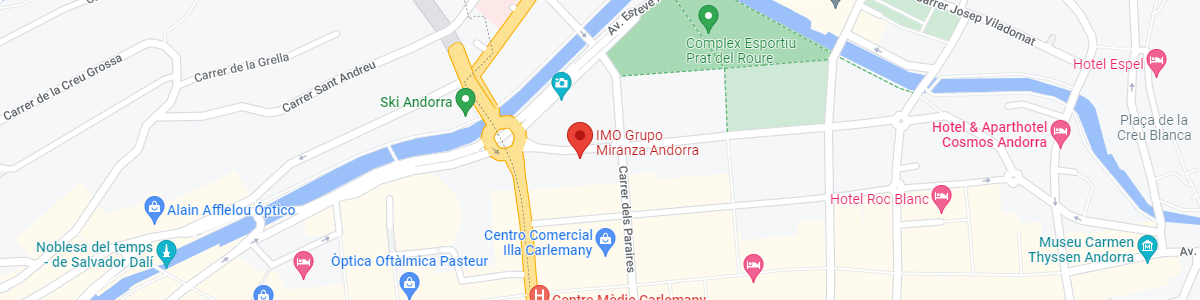
IMO Andorra
Av. de les Nacions Unides, 17
AD700 Escaldes-Engordany, Andorra
Phone: (+376) 688 55 44
See map in Google Maps